Currency risk, explained
A share can rise and still lose you money. Here’s how exchange rates change your real return — and how FolioCenter shows you your currency mix and what currency did to every holding.
Why currency matters
When you own something priced in another currency, you hold two investments at once: the asset itself, and the currency it trades in. Your return in your own money depends on both.
Say you live in the euro area and buy a US stock. Over a year the share price rises 5% in dollars, but the dollar falls 10% against the euro. In euros you are not up 5% — you are down about 5.5%:
Your return = (1 + price return) × (1 + currency return) − 1
(1.05 × 0.90) − 1 = −5.5%
It works the other way too. If the dollar had risen 10%, the same 5% share-price gain would have become about 15.5% in euros. Currency moves of 10% in a year are not rare, so over a few years they can matter as much as the companies you picked.
It cuts both ways
Currency risk is not only a threat. It is a second source of gains and losses that has nothing to do with how well your companies did — which is why it is worth seeing separately.
In the example portfolio below, Adobe is down €410 over the year in euro terms, but +€115 of that came from the dollar strengthening. Without it, the loss from the share price alone would have been about €525. Microsoft is up €985, of which €284 is currency.
Where currency risk hides
- The listing is not the business. A US company bought on a European exchange is priced in euros, but its value still follows the dollar. In the example below, AMD shows no currency gain because it is held on a euro listing — the dollar risk is still there, built into the euro price.
- Funds and ETFs. A world ETF bought in euros is mostly invested in US dollars and other currencies underneath.
- Dividends. A dividend paid in dollars is worth more or less in euros depending on the rate on the day it arrives.
- Cash. Uninvested dollars or francs at your broker carry currency risk too, even with no shares bought.
See your currency mix
Open Analysis → Currency Exposure to see how much of your wealth depends on each currency, for your whole fund or a single portfolio. Every holding and cash balance is valued in your base currency with daily exchange rates, so the weights add up to 100%.
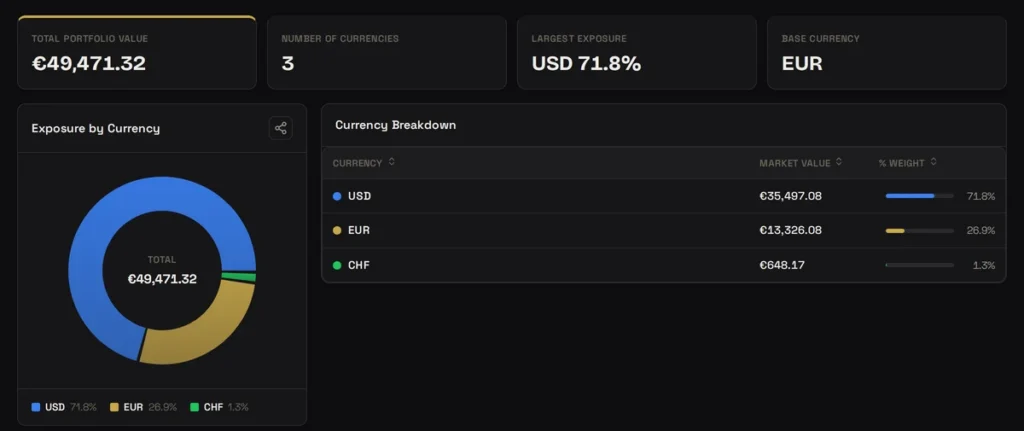
A portfolio that feels European can turn out to be mostly a bet on the dollar. Whether that is right for you depends on the currency you will eventually spend the money in — but it is worth knowing either way.
See what currency did to each holding
Open Performance → Calculation and pick a period. The unrealised and realised gains cards list every holding with two figures: the gain in your base currency, and the part of it that came from the exchange rate — the currency gain. The total for the period sits next to the card’s title, marked FX.
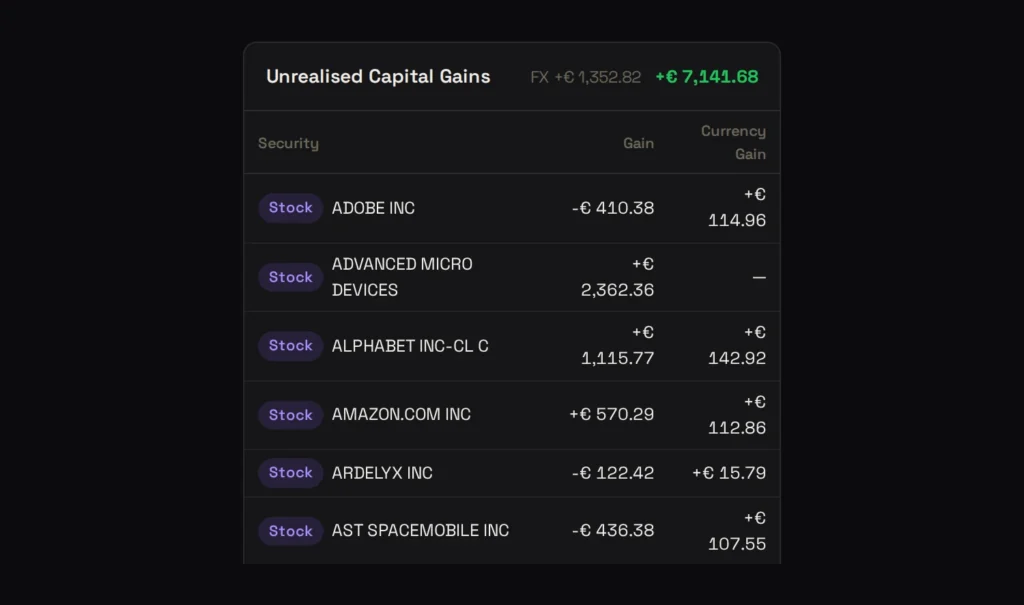
A dash means the holding is priced in your base currency, so there is no exchange-rate effect to separate out. Because benchmarks are also converted into your currency, comparisons stay fair too — see Benchmarks: compared with what?
Living with currency risk
There is no single right answer, but a few principles help investors decide how much currency risk to carry:
- Match your future spending. Money you will spend in euros carries less risk when more of it is in euros. Long-term savings can usually afford more variety.
- Diversify across currencies rather than betting on one, unless you have a reason to.
- Hedged share classes of many ETFs remove most currency movement, at a small yearly cost. They suit bonds more often than shares.
- Think in years, not weeks. Currencies swing in both directions; reacting to every move usually costs more than it saves.
Common questions
Brokers usually report a holding’s return in the currency it trades in. FolioCenter reports it in your base currency, so the currency effect is included — that is the return you actually got.
The holding is priced in your base currency, so there is no exchange rate to separate out. Its value can still depend on other currencies underneath — a US company on a euro listing, for example.
Not yet. Exposure is shown by the currency each holding is priced in. A world ETF bought in euros counts as euro exposure, even though most of what it owns is in dollars.
Daily reference rates, so values and currency gains reflect the rate on each day — not a single rate applied at the end.
Yes. Both screens have a selector at the top right to switch between your whole fund and a single portfolio.
See what currencies are doing to your returns
Import your accounts and see your currency mix — and the currency gain or loss on every holding — in one place.
Start free →Already have an account? Sign in
The examples come from a real portfolio, over the year to 8 October 2026. This guide explains how currency affects returns and how to read FolioCenter; it isn’t investment advice.